
Walk through any supplement store and you’ll find plenty of products promising more energy, less fatigue, and faster recovery. Some of those claims sound impressive because they involve real processes taking place inside the body. The difficult part is determining whether those processes translate into something useful when we actually train.
Citrulline malate (CM) is a good example. It has attracted attention among resistance trainers because of its proposed ability to reduce muscular fatigue and improve performance. Rather than relying on what a supplement is supposed to do, it makes sense to look at what researchers have found when people take it before exercise.
What exactly is citrulline malate?
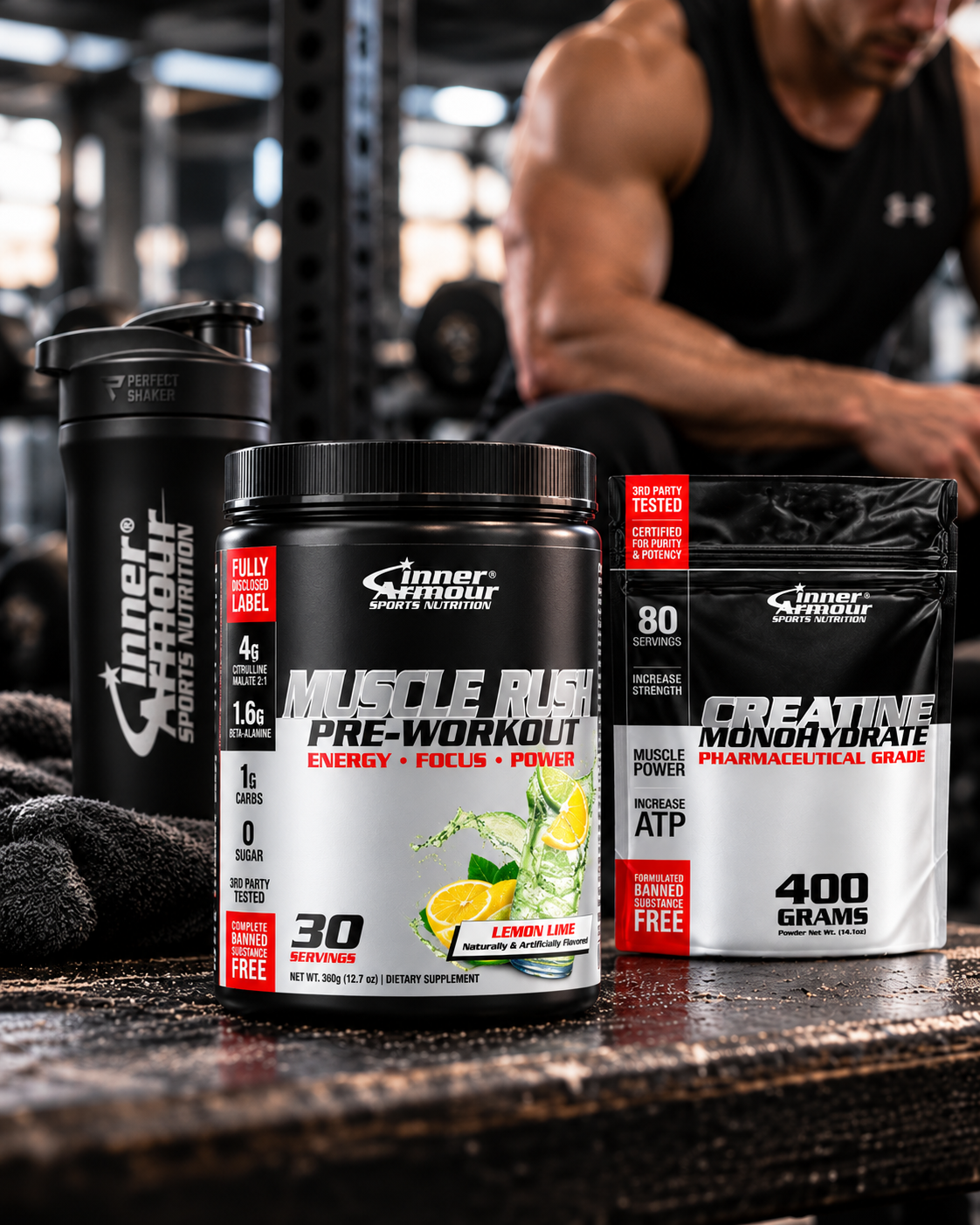
CM combines citrulline, a nonessential amino acid found naturally in foods such as melon, with malate, a compound related to malic acid and involved in energy metabolism. After citrulline is absorbed, some of it is converted to L-arginine. Arginine helps the body produce nitric oxide, which plays a role in regulating blood flow and other functions important to working muscles.
There is another side to the story. Citrulline participates in the urea cycle, one of the body’s systems for managing ammonia produced during metabolism. Malate is involved in cellular energy pathways. Put together, these functions offer several possible explanations for why CM might influence fatigue.
Of course, knowing how an ingredient behaves chemically is not the same as proving it will help someone lift more weight or complete another repetition. That is why the human exercise studies are more interesting than the advertising.
What happened in the gym?
A study discussed in the original review by Guisado and Jakeman (2010) looked at 41 men performing barbell bench presses. Using a two-period crossover design, the researchers gave participants either eight grams of citrulline malate or a placebo before an exercise session. The men then performed repetitions with a load set at 80 percent of their previously determined one-repetition maximum.
Under the CM condition, participants managed more repetitions before reaching fatigue. Researchers also reported less muscle soreness over the days that followed, with a reduction described as approximately 40 percent. For anyone who has struggled through the last few sets of a workout, it is easy to see why those findings caught attention.
Still, the details matter. This was a particular group of men, using a particular dose and training protocol. It suggests CM may offer an advantage in some high-intensity resistance exercises. It does not mean that everyone taking a pre-workout product will experience the same increase in performance or reduction in soreness.
Looking at what happens inside the muscle
A separate investigation by Bendahan and colleagues (2002) considered the energy side of fatigue. Eighteen men who had previously complained of fatigue took part in a study that included a small-muscle exercise task. Researchers used specialized measurements to examine energy production during exercise and recovery afterward.
The results reported a 34 percent increase in oxygen-dependent ATP production during exercise and a 20 percent improvement in phosphocreatine recovery following activity. ATP is the immediate source of energy that allows muscles to contract, while phosphocreatine helps replenish that supply during short bursts of effort. These findings offered a possible explanation for the performance effects seen in other research.
But the study also illustrates why promising results need careful interpretation. It involved a small sample and, as later reviewers pointed out, lacked a conventional control group. Without that comparison, it becomes harder to separate an effect of supplementation from other possible explanations.
Nitric oxide, circulation, and the trained athlete
One of citrulline’s main selling points involves nitric oxide. Because citrulline can raise arginine availability, researchers have been interested in whether it can influence the way blood vessels function during or after exercise. Better circulation sounds appealing, especially when muscles are working hard, but there is more to performance than a single physiological response.
Sureda and Pons reviewed research into arginine and citrulline in sport and exercise, including findings related to nitric-oxide-associated metabolites and recovery responses in competitive cyclists. Their discussion raised an important issue: athletes who have trained for years may already be highly adapted to the demands of exercise. A supplement that appears helpful in a recreationally active person might produce a smaller, less consistent, or harder-to-detect effect in a competitive athlete.
They also drew attention to limitations in earlier work. The bench-press trial, for example, found performance changes without directly measuring nitric oxide markers. The muscle-energy study lacked a control group. Neither criticism makes those studies worthless. It simply means we should be careful about claiming to know exactly why a benefit occurred.
Does the evidence hold up in people who already train?
Wax, Kavazis, and Luckett (2015) investigated CM in fourteen college-age men who regularly trained. In a randomized, double-blind experiment, participants performed exercises such as chin-ups, reverse chin-ups, and push-ups to fatigue. The researchers also measured variables including heart rate, blood pressure, and blood lactate.
They reported improvements in certain resistance-exercise performance measures after CM supplementation. This is worth noting because the participants were not entirely new to exercise. At the same time, fourteen people is a small sample, and improvements in a specific set of bodyweight exercises do not automatically predict the result of every training program.
Across these studies, the pattern is interesting without being conclusive. There are signs that CM can influence the number of repetitions completed and possibly perceptions of soreness or recovery. What remains much less certain is how large that effect is, which people benefit most, and how consistently the findings apply outside a laboratory.
Three reasons researchers think it might work
The original review considered three overlapping mechanisms. First, citrulline’s role in the urea cycle may help the body process ammonia associated with metabolism during demanding exercise. Second, malate is involved in energy-producing pathways, which could influence how working muscle meets its fuel demands. Third, citrulline’s conversion to arginine may affect nitric oxide production and blood-vessel regulation.
All three are worth studying. But muscular fatigue is not caused by one substance building up or one chemical process slowing down. Training intensity, available energy, hydration, rest intervals, and individual conditioning all matter. It would be misleading to point to one of these mechanisms and claim it fully explains the effects of CM.
What about the dose and side effects?
The studies cited in MacDonald’s review discussed doses in the range of roughly four to ten grams around exercise, including the eight-gram dose used in the bench-press experiment. These are descriptions of older research protocols, not a universal recommendation. Different products may also contain different ratios of citrulline and malate, making direct comparisons difficult.
In the bench-press study, some participants reported stomach discomfort following ingestion. That is a useful reminder that a supplement can be promising and still have drawbacks. Anyone considering supplementation should review the actual product label and speak with a qualified health professional about personal concerns or medical conditions.
So is citrulline malate worth considering?
The early human research gives us a reasonable basis for continued interest, particularly where intense exercise involves repeated efforts and short rest periods. A few controlled experiments showed meaningful differences in performance, and some recovery measures also looked promising. But the original researchers and reviewers identified real limitations, especially when it came to the size of studies, the measurement of proposed mechanisms, and the differences between recreational and highly trained athletes.
There is no shortage of products that promise a shortcut to better results. Citrulline malate is more interesting than a promise alone because it has been put through human exercise trials. That does not make it essential. Consistent training, a suitable diet, and enough recovery still do most of the work. Whether CM provides a useful extra benefit is a question that deserves continued research rather than a guaranteed answer.